
Plant & Tree Care Instructions
We have a 30-day limited plant warranty from the date of installation.
If a plant dies in that timeframe, it will only be replaced one time.
Please check your new plants regularly to make sure they stay healthy.
Call or text me if you have any concerns about the health of your plants after reading this. I’m here to help if you have any questions.
Watering Guide
Water plants according to their individual needs and current weather conditions. Watering requirements will vary depending on plant type, temperature, rainfall, soil conditions, and sun exposure.
How to Determine Your Plant’s Watering Needs
Check soil moisture approximately 24 hours after your last watering. This helps determine whether your plants are receiving too much, too little, or the correct amount of water.
Step 1: Check the Root Ball/ Soil
Slide your hand into the soil between the surrounding dirt and the plant's root ball. Reach halfway down the root ball, or deeper if possible.
Step 2: Feel the Soil
Grab a handful of soil from alongside the root ball. Determine if the soil is dry, moist or wet.
Step 3: Adjust Your Watering
Dry soil: Increase your watering frequency or duration.
Moist soil: Maintain your current watering schedule.
Wet or soaked soil: Reduce your watering frequency or duration.
HOT WEATHER WATERING
First 2 Weeks:
Water once or twice daily as needed, depending on the plant, weather, and soil conditions. (early-morning watering is preferred)
Make sure water reaches the entire root ball.
Weeks 3–4:
Gradually reduce watering to once daily or as needed.
Adjust watering based on rainfall and plant health.
After the First Month:
Continue watering as needed during hot weather.
Gradually decrease watering frequency as plants become established.
COOL WEATHER WATERING
First Month:
Water approximately once daily as needed, depending on temperature, rainfall, and plant type.
Avoid watering if the soil is already saturated.
After the First Month:
Gradually decrease watering frequency as plants become established.
Adjust watering based on weather conditions and plant health.
IMPORTANT WATERING TIPS
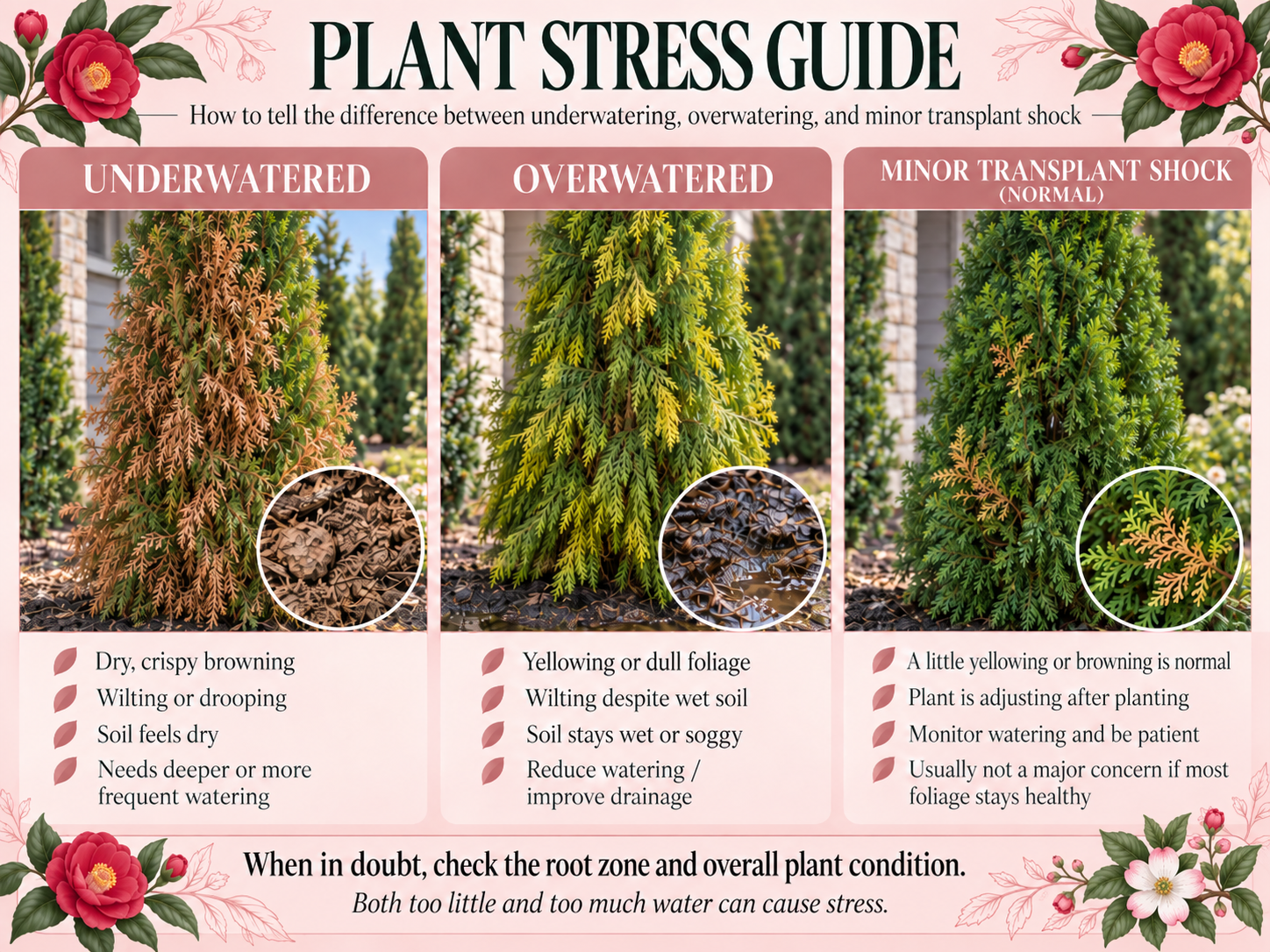
Signs of underwatering: Drooping, curling leaves, crispy edges, or wilting may indicate plants need more water.
Signs of overwatering: Yellowing leaves, constant wilting despite wet soil, or soggy conditions may indicate too much water.
Water deeply: Water should soak down through the entire root ball, not just wet the surface.
Rainfall: If heavy rainfall thoroughly soaks the root ball, additional watering may not be necessary that day.
Adjust as needed: Different plants have different watering requirements. Increase or decrease watering based on weather and soil moisture.
IMPORTANT: Overwatering can kill plants just as quickly as underwatering. The goal is to keep roots adequately moist without leaving them constantly saturated.
HOSE WATERING GUIDE: HOW LONG TO WATER EACH PLANT
Deep watering is essential for newly installed plants. Water should penetrate the entire root ball rather than just wetting the surface.
Use a garden hose with a gentle, controlled spray by placing your thumb partially over the hose opening or using an adjustable watering nozzle.
HOSE WATERING INSTRUCTIONS
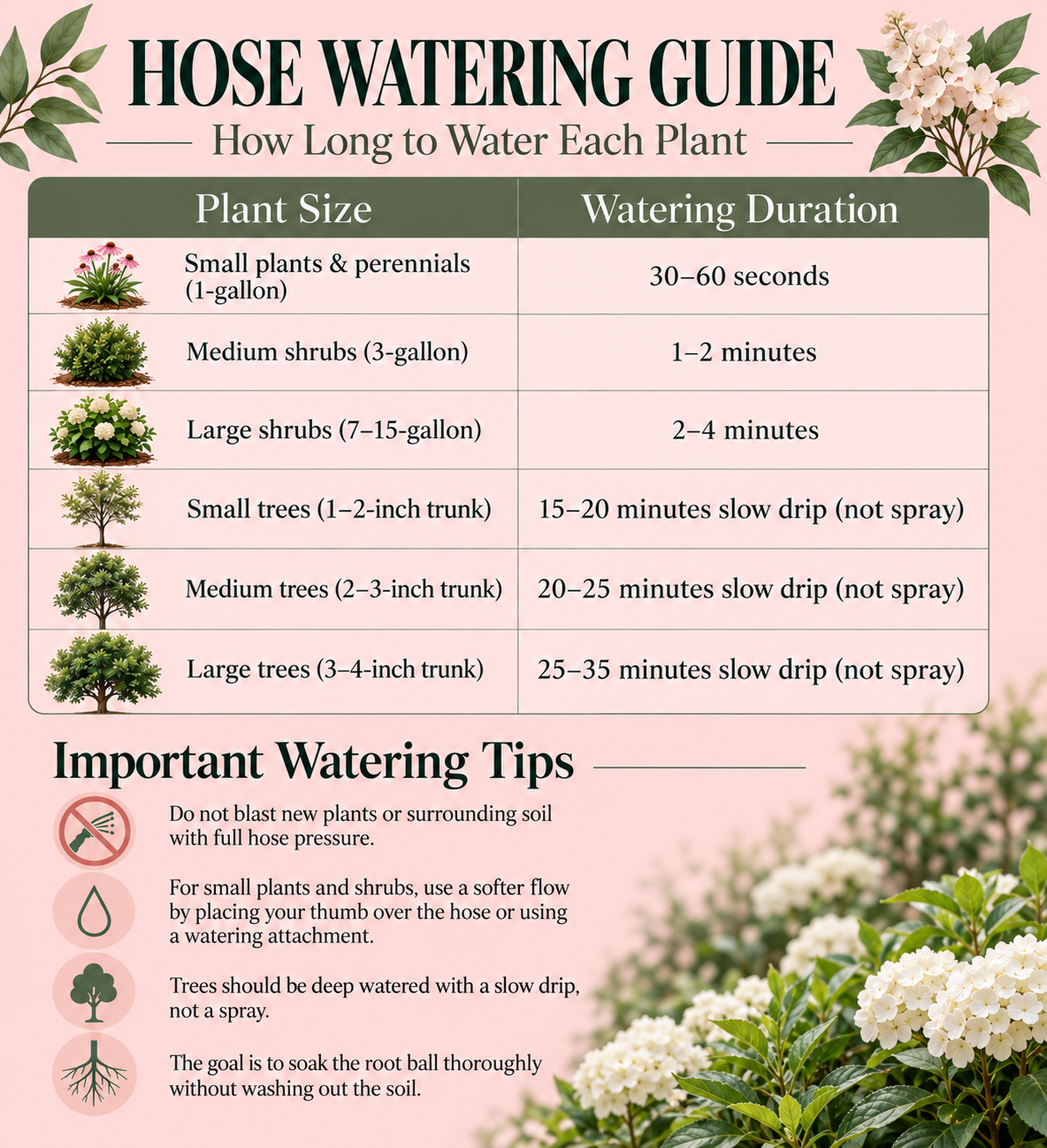
Do not spray your trees with a hose they require a slow trickle/drip (Read our tree instructions below for more information.)
These are approximate starting times for a gentle hose flow of 1–2 gallons per minute. Actual watering times vary depending on water pressure, root ball size, and soil conditions.
PROPER WATERING TECHNIQUE
Use a gentle spray: Place your thumb over the hose opening or use an adjustable hose nozzle to soften the water pressure.
Never blast your plants: Do not spray plants or surrounding soil with the full force of an unrestricted hose. Strong water pressure can damage delicate plants, wash away soil, and expose roots.
Water at the base: Direct water around the root ball rather than spraying the leaves and branches.
Avoid flooding: If water begins pooling or running off, pause and allow it to soak in before continuing.
Adjust as needed: Larger plants generally need more water. Reduce watering during rainy weather or when soil is already saturated.
TREE/LARGE PLANT CARE INSTRUCTIONS
DEEP WATERING IS ESSENTIAL
Deep, slow watering is much more effective than quick, shallow watering. Newly planted plants need water to penetrate the entire root ball to encourage healthy root development.
Water should be applied slowly and directly around the root ball, allowing it to soak deeply into the soil without running off.
RECOMMENDED WATERING METHODS
Slow-Drip Garden Hose: Place a garden hose near the root ball and adjust it to a very slow, steady trickle. Allow approximately 20–30 minutes as a starting point, adjusting the duration based on water flow, tree size, and soil conditions.
Soaker Hoses & Tree Watering Bags: These products are available at Home Depot, Lowe's, and most garden centers. They slowly release water around the root zone for more effective absorption.
Drip Irrigation: One of the best options for consistent, controlled watering. Drip systems deliver water directly to the roots while reducing waste. Lady Landscape offers professional drip irrigation installation.
We highly recommend installing an irrigation system to ensure your new trees receive consistent watering, especially during hot weather or when you're away from home.
WATERING SCHEDULE
First Week:
Water approximately once daily, adjusting for weather and soil conditions.
Second Week:
Begin gradually reducing watering to every other day, as conditions allow.
Third Week & Beyond:
Gradually transition to every third day or as needed.
Continue deep watering throughout the establishment period, especially during hot, dry weather.
Larger trees may require supplemental watering for several growing seasons.
Rainfall: Skip watering when rainfall has thoroughly soaked the root ball. Light rain or drizzle may not provide enough moisture to reach the roots.
IMPORTANT REMINDERS
Water slowly and deeply rather than quickly flooding the rootball.
Keep water concentrated around the root ball and surrounding root zone.
Adjust watering based on rainfall, temperature, and soil conditions.
Newly planted plants require consistent care until their roots become established.
IMPORTANT: If you notice any changes in your plant's health, please contact Lady Landscape as soon as possible. Addressing problems early gives your trees the best chance of recovery.
WATCH FOR SHOCK:
It's normal for newly planted trees and shrubs to experience some transplant shock while adjusting to their new environment.
Signs of transplant shock include:
Leaves turning yellow or brown
Leaves curling, wilting, or dropping
Crispy or dried-out leaf edges
Overall decline in plant appearance
If you notice these symptoms, check your soil moisture before adjusting your watering. Both overwatering and underwatering can cause similar symptoms. Contact Lady Landscape if you're unsure.
HOW LONG DOES ESTABLISHMENT TAKE?
Fall & Winter Planting: Cooler temperatures generally reduce stress and allow roots to develop before summer.
Spring & Summer Planting: Hot weather places additional stress on newly installed plants, which may require extra attention throughout the warm season.
Full Establishment: Trees and shrubs may take one or more growing seasons, and larger trees can take several years to fully establish.
FERTILIZING & MAINTENANCE
Fertilizing: Allow newly planted trees and shrubs time to establish before fertilizing. Once established, use a fertilizer appropriate for the plant's needs. Avoid applying fertilizer directly against roots or trunks.
Pruning: Remove completely dead or damaged branches as needed. Brown or dead leaves may be removed for appearance, but avoid unnecessary pruning of healthy growth while plants are establishing.
Plant Health: Some yellowing or leaf loss is normal after planting. However, continued decline, excessive leaf drop, or severe wilting should be addressed promptly.
IMPORTANT: Waiting too long to address a struggling plant can result in permanent damage or death. Early attention gives your plants the best chance of recovering.
If you're concerned about your plant's health, please contact Lady Landscape as soon as possible.
How to Protect Plants
Deer & Animal Spray & Pellets
Use to keep deer and rabbits from eating plants. For the spray, use on leaves every two months or after rain. Pellets can be used at the base of the plant and only needs to be used once every 2 months.
Links:
Bonide-Repels-All-Animal-Repellent
Bonide-Repels-All-Animal-Repellent-32-oz
NEEM OIL: Organic Spray ( Safe for pets & children )
Neem Oil kills insects and treats black spot/fungus.
Bonide-Neem-Oil-32-oz-Spray-Multi-Purpose-Fungicide-Insecticide-and-Miticide
MALATHION SPRAY:
Treats spider mites: tiny reddish insects that eat any evergreen needle (ex dwarf alberta spruce, blue spruce, pines, etc. If you see needles start to turn rust colored and/or fall off your evergreen trees, please immediately start spraying with malathion.
Spider mites can kill a tree completely in only a few days. The insects are so small you won’t see them. If you have this type of tree, you should keep a bottle of this on hand.
I check my evergreens almost every day when I walk to my mailbox! You’ll need the concentrate and a spray bottle.
Link: https://a.co/d/eqmfpy5
Link: https://a.co/d/eQXrOMN
Feeding Plants
MIRACLE-GROW SPRAY:
Attach the device to your hose and feed your flowers during blooming season or when you need extra growth.
Link: Miracle-Gro-64-oz-All-Purpose-Plant-Food-Fertilizer
AZALEA FOOD:
Great for acid-loving plants: azaleas, camellias, gardenias, loropetalum, hydrangeas, rhododendrons, etc.
(If you feed Encore Azaleas, you can get Spring, Summer, and Fall blooms)
Link: Vigoro-Azalea-Camellia-and-Rhododendron-Plant-Food
ROSE FOOD:
If you feed your roses during the blooming season, you’ll get more blooms!
Link: VigoroAll-Season-Rose-Plant-Food
EVERGREEN FOOD:
Evergreen plants such as emerald-green arborvitae, golden mops, blue spruce, etc., need food and added nutrition as well.
Link: Vigoro-Evergreen-Holly
ANY TREE/PLANT FOOD:
This is my favorite all-purpose fertilizer! If your plant isn’t missing any specialized nutrients, this is the way to go!